
Questions before the next step?
Find concise answers about Reflexlux, its applications, dimensions and important considerations for therapeutic use.
FAQs
We are often asked these questions about Reflexlux.
Is Reflexlux suitable for any level of performance?
Reflexlux can be adapted to a wide range of performance levels. Trainers and therapists can select suitable programs for athletes, older adults, children and adolescents, depending on the individual training goal and level of ability.
What is a Reflexlux Movement Therapist?
A Reflexlux Movement Therapist is a professional qualified by FINTEC Holding AG to use Reflexlux purposefully for a range of training and therapy goals. The qualification combines system knowledge, safety, program selection and practical application. At its heart is a new dimension of training and therapy: visual perception, cognition and full-body movement are combined in spatial tasks that can be adapted to each person's abilities and goals.
What makes Reflexlux special?
Reflexlux is far more than a light wall or reaction wall. The system is not primarily designed to touch illuminated targets as quickly as possible. What matters is which movement a light target triggers, where the target appears, in what sequence it is approached and which physical strategy is required to reach it.
The light targets act as spatial movement cues. Their position, height, distance, side and timing can be used to prompt specific movement patterns. These include expanding the range of motion, trunk rotations, weight shifts, cross-body movements, stepping sequences, balance reactions or coordinated movements of the hand, arm and foot.
In this way, Reflexlux translates a therapeutic or training objective into a concrete task in space. If the aim is, for example, to engage the affected side more strongly, initiate a movement across the body's midline, increase shoulder mobility or improve standing stability, a random light is not simply activated. Instead, a program is designed so that precisely the movements required for that objective must be repeated, varied and performed with increasing confidence.
At the same time, Reflexlux combines physical movement with perception and cognition. The person training must detect a signal, interpret its meaning, select between possible targets, plan a movement and execute it purposefully. Perception, attention, decision-making, coordination and movement therefore do not form separate exercise components, but interact directly.
A particular advantage lies in the system's spatial specificity. The targets are located at real, clearly defined positions and must actually be reached and touched. This creates a clear motor endpoint with immediate feedback. Movement direction, range, height and changes of side are not merely displayed visually; they must be performed physically.
The programs can be adapted to different abilities and objectives. Range, pace, number of repetitions, direction of movement, complexity and cue sequence can be selected so that both patients with substantial limitations and healthy or performance-oriented users are challenged appropriately. Assistive devices, starting positions and additional motor tasks can also be incorporated into the training.
Reflexlux is therefore not merely a technical system for measuring reactions, but a programmable, functional movement environment. A central element of the know-how lies in the purposeful selection and design of the movement patterns intended to support a desired adaptation.
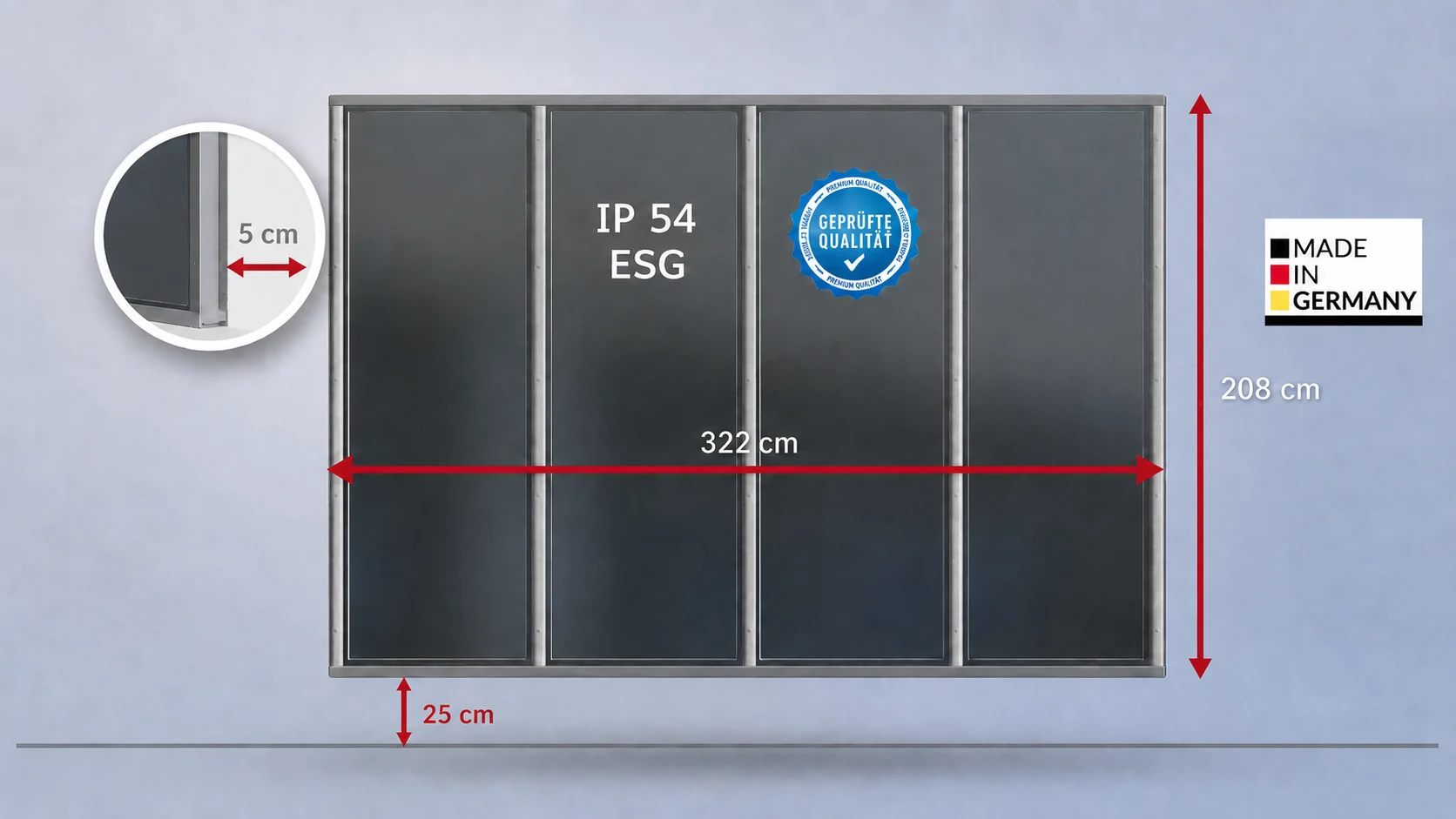
What are the dimensions of the Reflexlux wall?
A standard Reflexlux wall is designed as a modular wall system with four panels. The drawing shows the approximate layout and dimensions used for planning rooms, positioning and installation.
How safe is the Reflexlux glazing?
Reflexlux uses a 6 mm pane of thermally toughened safety glass (ESG), which is structurally integrated specifically for the system's mechanical requirements. Compared with ordinary flat glass, thermally toughened glass has significantly greater resistance to impact, shock and bending. If it breaks, it typically disintegrates into many small, predominantly blunt-edged fragments, thereby reducing the risk of serious cuts.
In Reflexlux, the glass pane is not held in a rigid mounting but is supported elastically in rubber around its entire perimeter. This helps cushion loads and reduce local stress peaks at the edges. In addition, each pane is supported from behind by 14 support rings positioned around the LED and sensor elements. These limit excessive inward deflection and distribute the forces that occur across several points.
A practical test illustrates how resilient toughened safety glass can be: a Reflexlux pane was supported only along its two opposite long edges on wooden beams and was then loaded with a person's body weight. Although the unsupported pane flexed far enough to touch the floor, it did not break. This test is not a normative proof of load-bearing capacity, but it clearly illustrates the considerable bending and load reserve of the glass used. The installation conditions within the Reflexlux system, with support around the entire perimeter and additional support points, are considerably more favourable than this deliberately intensified test arrangement.
In its intended use, the glazing is therefore highly resistant to touch, impacts from hands or feet and ordinary blunt loads. It cannot readily be destroyed by normal training movements or blunt force. Nevertheless, toughened safety glass remains a safety glass and is not indestructible.
As with any toughened safety glazing, particular caution is required with hard, pointed or sharp-edged objects. A concentrated impact from a metal object can create high local stress and cause the pane to disintegrate suddenly. Equipment, dumbbells, tools and other heavy, angular or pointed metal objects should therefore not be struck against the glazing or used unsecured immediately in front of it.
Why is visually guided movement training important?
A large proportion of our movements is prepared, guided and continuously corrected by visual information. Before a purposeful movement can be performed, a stimulus must be detected, located in space and translated into an appropriate motor action. Only the interaction of visual perception, attention, spatial orientation, movement planning and movement control makes safe and functional action possible.
Reflexlux integrates these processes directly into movement. The person training sees a light signal, identifies its position in space, orients their gaze, head and body towards it, plans the required movement and reaches the target with their hand or foot. Gaze control, head and trunk alignment, balance, reach and coordination are combined into a coherent sequence of actions.
Depending on the program, different visuomotor demands can be targeted. These include detecting stimuli in the central or peripheral visual field, rapid shifts of gaze and orientation, eye-hand or eye-foot coordination, orientation towards different sides and heights in space, crossing the body's midline, and adapting movement direction, reach and body position to a visual cue.
Another important aspect is cooperation between the two cerebral hemispheres. Many movement tasks require interhemispheric transfer, meaning the rapid exchange of information between the left and right hemispheres. Particularly during cross-body movements, changes of side or the targeted involvement of one side of the body, visual information and motor control processes must be coordinated across both hemispheres. Reflexlux can support these processes through purposefully designed movement sequences and make them repeatedly tangible.
In neurological rehabilitation in particular, however, it is not always appropriate to confront patients with complex virtual scenes, numerous colours, moving backgrounds or a large number of simultaneous stimuli. Such settings can be motivating, but they can also consume attention, make orientation more difficult or overload patients cognitively and visually. There is then a risk that the intended movement is no longer the focus and that processing the environment takes precedence.
The use of single-colour lights in Reflexlux is therefore a deliberate conceptual decision. The clear light signal reduces the task to its essentials: one target becomes unambiguously visible and triggers a defined movement. Visually distracting content is omitted so that the person training can concentrate on orientation, movement planning and execution.
This reduction does not mean that the training is simple or undemanding. Instead, complexity arises from the movement task itself: target position, height, side, reach, movement direction, sequence, pace and repetition. The level of demand can therefore be increased precisely without burdening patients with unnecessary visual complexity.
For patients with impaired attention, visual uncertainty, neurological deficits or reduced tolerance, this clarity can be a significant advantage. It enables training that remains unambiguous, understandable and controllable. The patient immediately understands where to move and receives clear feedback by reaching and touching the target.
Reflexlux therefore does not train vision in isolation. The system trains the entire functional chain from visual perception through spatial orientation and interhemispheric processing to purposeful movement. The visual signal serves as a precise cue for the movement patterns that are intended to be prompted, repeated and improved for therapeutic or training purposes.
Is the development of Reflexlux based on scientific evidence?
The decisive impulse for Reflexlux arose from the decades of practical experience of Johann Haase. His work in martial arts, health-oriented training and the EMS sector led him to take an increasingly critical view of conventional fitness concepts, in which muscles and movements are often trained in isolation. This gave rise to the conviction that effective training must engage the whole person more holistically: through functional movement patterns, spatial orientation, coordination and the active involvement of perception and attention.
This practical experience was combined with the foundational neuroscience and expert knowledge of the Center for Neuroscientific Research in Trier (ZNF). ZNF has a long-standing scientific tradition of investigating how the brain controls human behaviour and movement. Particular areas of focus include perceptual and processing mechanisms, cooperation between the two cerebral hemispheres, cortical plasticity, functional reorganisation and neurorehabilitation. This is complemented by extensive experience in developing and validating new diagnostic, rehabilitative and technology-assisted methods. This work is documented in numerous scientific publications and proprietary developments.
Can Reflexlux be used in neurological rehabilitation?
Yes, Reflexlux can be used as a configurable training environment in professionally supervised neurological rehabilitation, for example after stroke or with movement disorders. It does not replace diagnosis, medical treatment or an individual therapy plan, but can help therapists create purposeful visual, cognitive and motor tasks.
How can Reflexlux support patients after stroke?
After stroke, rehabilitation often focuses on meaningful goals, attention, perception, balance, strength and relearning everyday movement patterns. Reflexlux allows therapists to place light targets in space and adapt each task to the patient's abilities, for example through visual search and spatial orientation tasks, reaching, stepping, bilateral coordination or the gradual rebuilding of confidence in movement.
Is Reflexlux suitable for Parkinson's disease?
For people with Parkinson's disease, Reflexlux may be used by experienced therapists to create clear external movement targets and structured tasks for coordination, movement amplitude, reaction, balance and gait-related exercises. Training intensity and support should always be adapted to symptoms, fatigue, the timing and effects of medication and the individual's fall risk. Please take a look at our Parkinson’s disease video.
What should be considered with spasticity?
With spasticity, Reflexlux should only be used after therapeutic assessment and as part of a goal-directed plan. The system can support slow, controlled and motivating movement tasks, but the range of motion, speed, body position and support aids must be chosen carefully to avoid triggering excessive tone or unsafe compensation.
Can the exercises be adapted to very different patient abilities?
Yes. Tasks can be adapted by changing target height, target distance, reaction time, sequence complexity, use of one or both sides of the body, and whether the patient trains sitting, standing or with support. This makes it possible to start simply and progress step by step.
What does Functional Longevity mean?
Longevity is often associated with extending lifespan. But quality of life also depends on how long physical and mental abilities are preserved.
The WHO therefore describes healthy ageing in terms of "functional ability" - a person's ability to remain active over time, move, make decisions and live as independently as possible.
Functional Longevity builds on this idea: it is not only the number of years that matters, but the abilities we retain throughout those years.
For Reflexlux, this means training perception, cognitive processing and movement as an integrated whole rather than treating them separately.
Why is Reflexlux particularly well suited to Functional Longevity?
Many abilities that matter in everyday life work only in combination. We perceive something, interpret the information, decide how to respond and translate that decision into movement.
Reflexlux maps this sequence in an interactive training environment: See → Perceive → Decide → Move.
A light signal is not simply observed. It creates a task that requires a physical response. Visual orientation, attention, reaction, movement planning, coordination and mobility can all be addressed within the same task.
This integration is what makes Reflexlux relevant to Functional Longevity: the aim is not to train one ability in isolation, but to bring physical and cognitive capacity together in purposeful action.
Why should Functional Longevity begin before older age?
Functional Longevity is not training against age. The idea is to use and challenge abilities while they are available.
The longevity market is also changing perspective. Healthy aging is increasingly becoming relevant before limitations occur. Younger people are taking a proactive interest in preserving physical and cognitive capacity over the long term.
This fits the Reflexlux approach: training can be adapted to widely different performance levels. The same basic connection between perception, decision-making and movement can be addressed through simple tasks as well as fast and complex movement sequences.
Functional Longevity therefore does not begin at a particular age. It begins with the decision to keep using our abilities actively over time.
What roles do efficiency and motivation play in Functional Longevity?
Health concepts designed for the long term must also fit sustainably into everyday life. A training approach may be well founded, but if it is too time-consuming, monotonous or difficult to integrate, people are less likely to practise it regularly.
Reflexlux combines several demands within a single training task. Movement, perception, attention, reaction and coordination do not have to be addressed one after another in separate exercises; they can form part of the same task.
The playful character also matters. Each new light creates an immediate target, progress can be experienced directly, and a variety of programs can also be completed together with others.
Reflexlux therefore brings together two factors that matter particularly for Functional Longevity: compact training that is easy to integrate and the motivation to practise it regularly.